
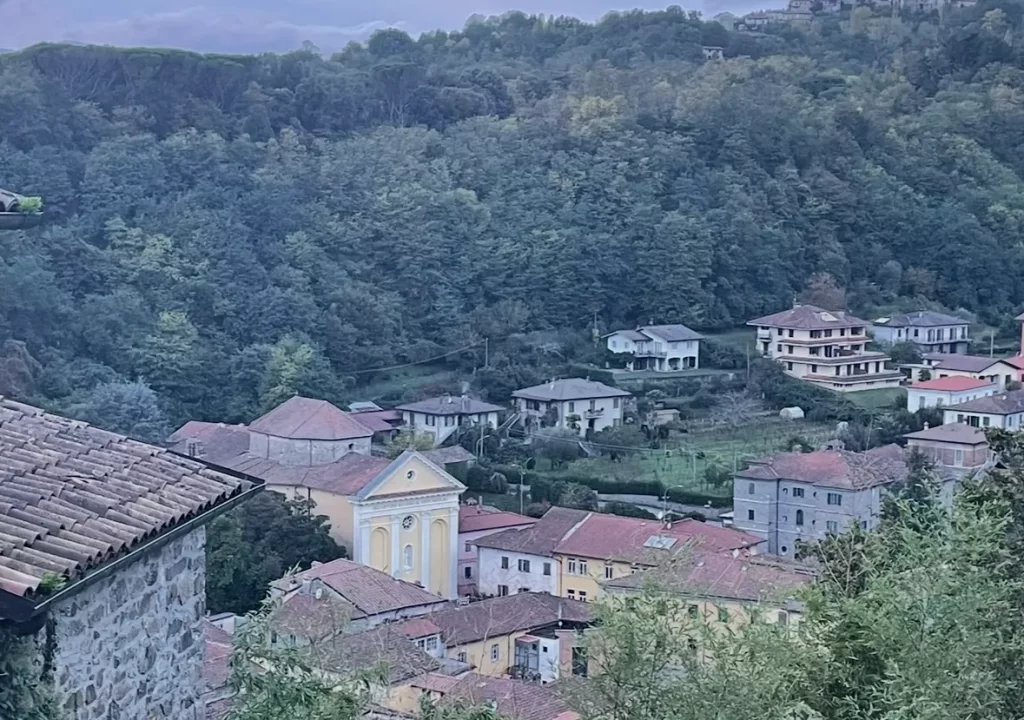
When I drove under the welcoming arch at the entrance to the village of Bagnone (pronounced ban-yo-nay), I was in awe. The first thing you see is the imposing castle on the top of a mountain. The castle was first mentioned in a document dated 963, making it well over 1,000 years old. I drive through the main piazza (square) and am greeted by a very narrow (one car) winding cobblestone street, Via della Republica, lined with huge stone buildings that now house shops, businesses and residences. It’s a bit of a game of chicken to get through this center of town. The cobblestone road is not straight but rather windy through the buildings. A place or two to pull over to let a car pass, but otherwise hoping no one is approaching as you can’t see past a bit in front of you.
You can’t quite tell yet, but that windy road and collection of buildings follows the curves of the a part of the Magra River known as the “Bagnone Torrent,” a beautiful rushing part of the river with waterfalls that flows through Bagnone. It originates in the Monte Sillara, the highest peak in the striking Appenine Mountains. A charming arched stone Ponte Vecchio (old bridge) — the same name as the famous one in Florence — allows pedestrians to cross over to the other side and up the path to the castle.
 Castello di Bagnone
I discovered Bagnone through a friend that used to have a home there. I was on my first-ever trip to Italy, visiting her. She landed in this village very randomly and, it turns out, with a remarkable stroke of luck. Bagnone is nestled in the Lunigiana region of Tuscany. Lunigiana translates to “The Land of the Moon” which summons up thoughts of romance and tranquility. It is flanked by the Appenine Mountains, filled with beautiful trees and dotted with lovely old homes. Bagnone is often referred to as “The Pearl of Tuscany” for its lovely mediterranean climate, natural beauty and rich history.
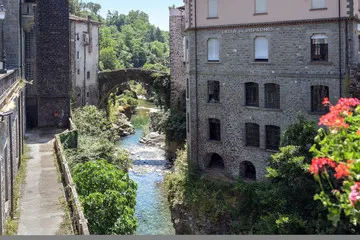
Ponte Vecchio over the river